
How to onboard a sales rep so they close enterprise deals by month 3

Table of Content
Most enterprise AEs take 6 to 9 months to ramp. By the time they close their first deal, you've burned $150K in salary, missed a quarter, and are wondering whether you made the right hire.
Here's the thing: the ramp isn't long because enterprise sales is hard. It's long because most onboarding plans are either nonexistent or built like product training. Nobody shadows real calls systematically. Nobody debrefs the first discovery meeting in depth. Nobody puts a new rep on a live deal with scaffolding before throwing them in solo.
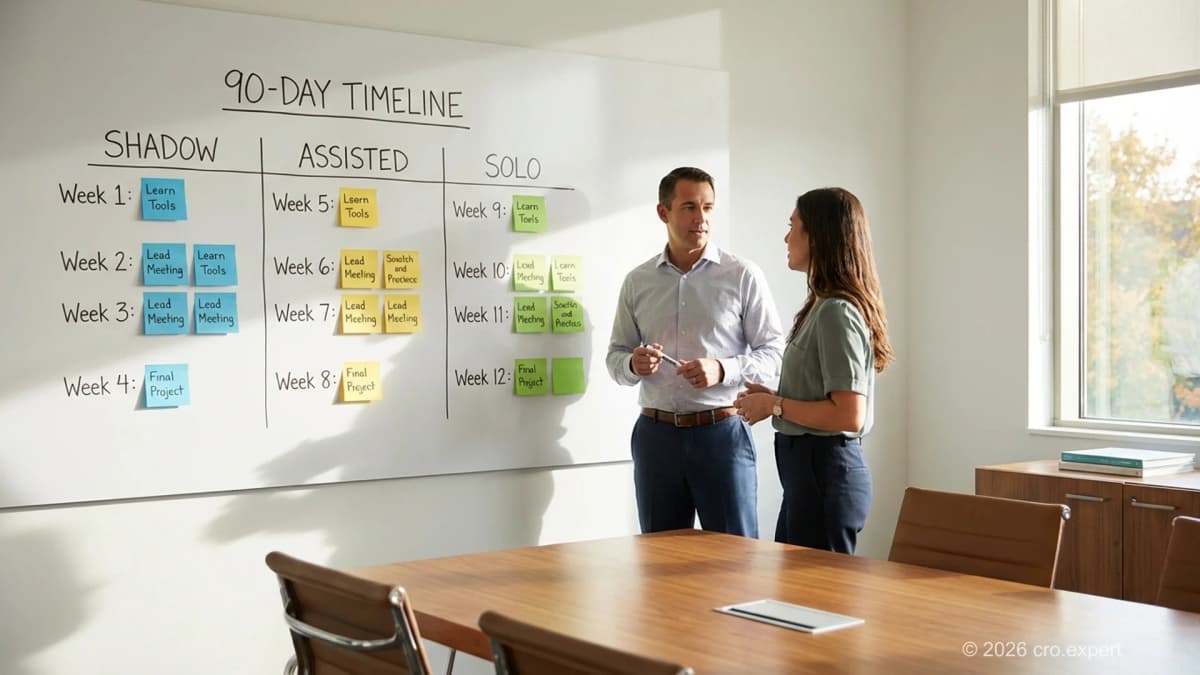
Enterprise sales rep onboarding done right looks more like a residency than an orientation. You move from observation to assistance to independent execution, with clear gates between each stage. That's how you get a first close in week 11 instead of month 7.
This is the week-by-week framework I've used across multiple SaaS and B2B services companies. It works when you actually do it, not just when you plan it.
Why enterprise sales rep onboarding takes so long by default
The average enterprise AE ramp is 6.2 months according to Pavilion's 2024 Go-to-Market Benchmarks report. At complex deals above $100K ACV, that stretches to 9 months. Most teams accept this as a fact of life. It's not.
The problem isn't the complexity of the product. It's the structure of how you introduce the rep to the actual motion.
Three things cause most ramp delays:
- Product knowledge taught before process knowledge. New reps spend two weeks in product certification before they've watched a single sales call. They learn features they can't yet contextualize.
- Too-fast handoff to solo work. Most onboarding plans have a rep running their own discovery calls by week 4. That's before they have mental models for objection handling, deal qualification, or what a good discovery actually sounds like.
- No structured feedback loop. The manager reviews pipeline on Friday but doesn't listen to recordings during week 1. The rep forms bad habits with no one catching them.
The irony is that faster solo handoff doesn't shorten ramp. It extends it. Reps who go solo too early develop wrong patterns that take months to unlearn.
The solo-too-fast trap
Putting a new enterprise AE on solo calls before week 8 is one of the most common ramp mistakes. It feels efficient. It isn't. Reps who go solo without enough shadowing spend their first 60 days making recoverable mistakes that take another 60 days to correct. The 2-week delay from structured shadow work pays back 3x in deal quality.
What a 90-day ramp actually requires from you as the manager
Before touching the week-by-week plan, be honest about what a compressed 90-day ramp requires from you.
You need to invest roughly 5-7 hours per week in the first month alone. Call debriefs, deal reviews, joint calls, feedback sessions. If you don't have that time, the rep will ramp on the standard 6-month timeline whether you plan for 90 days or not.
A few non-negotiables:
- You or a designated senior AE must be the shadow host for at least the first 10 calls
- You need a call library: 5-10 recorded calls with good examples of discovery, demo, and negotiation
- The rep needs a live deal to join as an observer or co-seller in week 3, not week 8
- You need a milestone scorecard to know whether you're on track or falling behind
This is where fractional sales leadership can actually accelerate things. If you don't have the bandwidth to run structured onboarding yourself, having a senior leader own the first 30-day program is a legitimate option, not a cop-out.
If you're hiring your first or second enterprise AE, also read the middle managers as the backbone of sales growth article. The coaching infrastructure you build for your first AE is the same one you'll use when you have five of them.
Weeks 1-2: foundation before the first call
The first two weeks aren't about product. They're about context.
The new rep needs to understand three things before they're useful on any call: who your buyers are (actual job titles, actual pain points), what your sales process looks like from the buyer's side, and what a good deal looks like in your pipeline versus a bad one.
Here's the specific agenda I use:
Days 1-3: ICP deep-dive. Read 10 customer case studies. Interview two existing customers (not just watch recordings, actually talk to them). Map the buying committee for your typical deal.
Days 4-7: Process and methodology. Walk through your sales playbook. If you don't have one written down, this is the moment it becomes obvious. Map each stage in your CRM against the real buyer decision milestones.
Days 8-10: Call library review. Watch 8-10 recorded calls from your best AEs. The rep should take notes on what questions are asked, how objections are handled, and what makes the buyer lean in.
At the end of week 2, the rep should be able to describe your ICP, explain why a deal stalls at proposal stage, and recite your top 3 competitive differentiators without prompting. If they can't, don't move to shadow calls yet.
Worth noting: product training doesn't need to be complete before the first shadow call. A working knowledge of the product is enough. Deep certification can run in parallel over the first 30 days.
Weeks 3-5: shadow phase and structured observation
Shadow work is the most underused tool in sales onboarding. Most managers treat it as passive — the new rep joins calls and watches. That's not shadowing. That's tourism.
Structured shadow work means the rep prepares before each call, observes with specific focus areas, and debriefs immediately after.
How to run a shadow call
Before each call, give the rep one specific thing to watch for: How does the AE open the discovery? How do they handle the "we're already looking at a competitor" objection? What questions do they ask to establish financial impact?
After the call, within 30 minutes: ask the rep what they noticed, what they'd have done differently, and what question they'd add next time. You want a conversation, not a review form.
In weeks 3-5, the rep should shadow at least 8-10 calls across different deal stages: initial discovery, technical deep-dive, economic buyer meeting, negotiation, and a deal that's stalling. Variety matters more than volume.
The co-preparation drill
By week 4, start having the rep prep the call agenda alongside the senior AE before each meeting. They don't run the call, but they write the preparation document. After the call, you can see how close their expectations matched reality.
This drill catches qualification gaps early. If a rep thinks a deal is qualified and the senior AE doesn't, you want to know that now, not in week 10 when the rep has their own pipeline full of the same pattern.
Shadow call checklist
For each shadow session, the rep should arrive knowing: the deal stage and history, the buyer's role and likely agenda, and what outcome the AE wants from this specific call. After the call, the debrief should cover: what worked, what they'd change, one thing they'd try next time. If you skip the debrief, the shadow work loses most of its value.
Weeks 6-8: assisted selling and live deal entry
This is where most onboarding plans skip a critical step. They go from shadow to solo. The assisted phase in between is what makes 90-day ramp possible.
In the assisted phase, the new rep runs the call but has a senior AE or manager present. Not as a backup, as a structural safety net. The rep opens, runs discovery, handles objections — and the senior AE only steps in when the deal is at risk of being damaged.
Live deal entry
By week 6, the rep needs a live deal of their own. This means prospecting outreach, not inheriting a pipe. The deals they source themselves will be more invested in than any hand-me-down.
Give them a target list of 25-30 accounts in your ICP. Their job in weeks 6-8 is to generate 3-5 qualified first meetings from outbound. This number is non-negotiable. Getting to 0 first meetings is a ramp failure signal.
For each deal they enter in the CRM during this phase, do a quick qualification review together. What's the problem they're solving? Who's the economic buyer? What's the compelling event? This turns CRM hygiene into coaching.
The assisted discovery formula
For the first 2-3 solo discovery calls, use this format:
- Pre-call prep meeting (15 min): rep shares call plan, you add context or adjust framing
- Rep runs the call, you observe silently
- Post-call debrief (20 min) within the hour: what qualified, what didn't, what to do next
After the debrief, the rep updates the CRM record. You review it. Tight loop, every time.
Weeks 9-12: solo progression and first close
By week 9, the rep should have 3-5 active deals at various stages. They're running calls solo, but you're still in weekly deal reviews with enough depth to catch issues early.
The goal of weeks 9-12 is the first qualified opportunity moving to proposal stage, and ideally a first close by week 11 or 12.
Two things that matter here more than anything else:
Deal selection for the first close. Don't let the rep chase their largest, most complex opportunity as their first close. Pick a smaller deal in your ICP where the buying process is simpler and the timeline is short. A $15K deal closed in week 11 teaches more than a $150K deal that slips into month 5.
Proposal review before send. Every proposal in weeks 9-12 needs a manager review before it goes to the buyer. Not to rewrite it, but to confirm the qualification logic holds: is the economic buyer engaged? Is there a compelling event? Is the scope priced correctly? One bad proposal that generates a ghost teaches bad habits.
By the end of week 12, you want to see:
- At least one closed deal (even small)
- 3+ active opportunities with clear next steps
- First qualified pipeline at 2x monthly quota target
- Rep is tracking their own conversion rates and calling out their own patterns
Need help building a sales onboarding system that sticks?
A structured ramp plan is only as good as the coaching infrastructure behind it. If you're hiring your first or second enterprise AE and want to get the onboarding architecture right, advisory support can compress the learning curve significantly.
Explore advisory servicesKey milestones and progression gates to track
A 90-day ramp plan without measurable gates is a schedule, not a system. Each phase needs a "pass/hold" decision point before you move the rep forward.
Here's the milestone framework I use:
| Week | Milestone | Pass criteria | Hold signal |
|---|---|---|---|
| 2 | Foundation complete | Can describe ICP, explain deal stages, recite top objections | Can't qualify a hypothetical deal from a cold scenario |
| 5 | Shadow phase complete | Submits 10 debrief notes with quality observations, co-preps 3+ call plans | Notes are shallow; doesn't spot missed discovery questions |
| 8 | First meetings booked | 3-5 qualified first meetings from own outbound | 0-2 meetings; discovery calls aren't advancing to next step |
| 10 | First opportunity qualified | 1 opportunity at proposal stage with economic buyer engaged | Pipeline is full but deals aren't advancing; missing compelling events |
| 12 | First close | At least 1 closed deal (any size); pipeline at 2x monthly target | No close; pattern of late-stage stalls; proposals going dark |
The gate review conversation
At each milestone gate, have a 30-minute structured review with the rep. Walk through the scorecard together. If they pass, be specific about what they did well so it becomes repeatable behavior. If they're on hold, name the exact pattern you're seeing and the specific change needed. Vague feedback at a gate review is worse than no review.
The four ramp failure modes that kill new hires
Most ramp failures aren't about the wrong hire. They're about predictable structural failures that you can see coming if you know what to look for.
Failure mode 1: too fast to solo
The rep goes solo on discovery calls in week 3-4 before they have a mental model for what a good discovery looks like. They develop their own approach, which may or may not match your methodology. By the time you notice the problem, it's week 10 and you have a pipeline full of poorly qualified deals.
Failure mode 2: no structured feedback
The manager reviews pipeline numbers but doesn't listen to call recordings. The rep gets deal-outcome feedback ("that one went quiet") but not skill feedback ("you asked for the next step too early and the buyer felt pressured"). These are very different things.
Failure mode 3: wrong early deals
The rep's first 3-4 deals set their mental model for what a normal deal looks like. If those deals are inherited from a prior AE's failed attempts, they're starting with deals that already have bad momentum. Give new reps clean, fresh accounts to work.
Failure mode 4: quota pressure too early
Putting a full quota on a rep in month 2 creates the wrong behavior. They rush deals, skip qualification steps, and push timelines that aren't real. Sales rep onboarding for enterprise deals needs protected ramp quota — typically 25% of full quota in month 1, 50% in month 2, 75% in month 3.
How to measure enterprise sales ramp success
Most teams measure ramp by whether the rep closes something in the first 90 days. That's an outcome metric. You need leading indicators that tell you whether the rep is on track before week 10.
The five metrics worth tracking weekly during ramp:
Activity-to-outcome conversion. How many outbound touches does it take to get a first meeting? If the industry benchmark is 80 touches per meeting and your rep needs 200, that's a messaging problem you can fix in week 3 rather than month 5.
Discovery-to-qualified conversion. What percentage of first meetings advance to a qualified opportunity? Under 30% usually means the rep isn't asking the right qualifying questions. Over 60% means they're advancing deals that shouldn't be advancing.
Call quality score. Use a simple 10-point rubric on 2 calls per week during the shadow and assisted phases. Score: opening, rapport building, problem identification, budget qualification, compelling event, next step. Don't need to be elaborate; just consistent.
CRM data quality. Are records complete after each call? Missing next steps, empty economic buyer fields, and no close date are signs of a rep who isn't thinking in deal terms yet.
Pipeline velocity. At week 12, is the average deal age in their pipeline consistent with your sales cycle, or are they sitting on early-stage deals that have been there since week 7?
You can get 80% of this data from your CRM if it's set up correctly. If you're building a B2B sales advisory process from scratch, CRM governance and ramp metrics belong in the same design conversation.
Enterprise AE ramp benchmarks: where most teams stand
The benchmarks vary a lot by deal size and sales motion, but here's a realistic comparison from Forrester's B2B Revenue Planning guide and Pavilion benchmarks:
| ACV range | Average ramp time | With structured onboarding | First close milestone |
|---|---|---|---|
| <$25K | 3-4 months | 6-8 weeks | Week 8-10 |
| $25K-$75K | 5-6 months | 10-12 weeks | Week 10-12 |
| $75K-$200K | 6-9 months | 12-14 weeks | Week 12-16 |
| >$200K | 9-12 months | 16-20 weeks | Month 5-6 |
What to do at day 90: evaluate, extend, or exit
Day 90 is a decision point, not a graduation ceremony. Based on what you've seen across the 11 weeks, you're in one of three situations.
On track: The rep has closed or is actively negotiating their first deal. Pipeline is at 2x monthly target. CRM data is clean. They're asking the right questions in deal reviews without being prompted. In this case, move to standard quota and steady-state management.
Behind but recoverable: The rep has qualified pipeline but no close yet. They're 3-4 weeks behind the ideal milestone schedule. The coaching conversations are improving their behavior. This is an extension situation, not a failure. Give them 30 more days with the ramp quota, with one clear target: first close in the next 30 days.
Not working: No qualified pipeline at week 12, or pipeline exists but every deal has the same problem (wrong ICP, wrong buyer, no compelling event), and the coaching conversations aren't moving the needle. This is the hardest conversation, but it's a kindness to have it early rather than at month 6.
Honestly, the day 90 conversation is only difficult when the previous 89 days didn't have enough structured feedback. If you've been using the milestone gates, you shouldn't be surprised by the outcome.
Enterprise sales rep onboarding done right makes the 90-day evaluation feel like a formality. The real work happens in weeks 3-8, when the habits are forming. That's where you win or lose the hire.
Most enterprise AEs take 6 to 9 months to ramp. By the time they close their first deal, you've burned $150K in salary, missed a quarter, and are wondering whether you made the right hire.
Here's the thing: the ramp isn't long because enterprise sales is hard. It's long because most onboarding plans are either nonexistent or built like product training. Nobody shadows real calls systematically. Nobody debrefs the first discovery meeting in depth. Nobody puts a new rep on a live deal with scaffolding before throwing them in solo.
Enterprise sales rep onboarding done right looks more like a residency than an orientation. You move from observation to assistance to independent execution, with clear gates between each stage. That's how you get a first close in week 11 instead of month 7.
This is the week-by-week framework I've used across multiple SaaS and B2B services companies. It works when you actually do it, not just when you plan it.
Why enterprise sales rep onboarding takes so long by default
The average enterprise AE ramp is 6.2 months according to Pavilion's 2024 Go-to-Market Benchmarks report. At complex deals above $100K ACV, that stretches to 9 months. Most teams accept this as a fact of life. It's not.
The problem isn't the complexity of the product. It's the structure of how you introduce the rep to the actual motion.
Three things cause most ramp delays:
- Product knowledge taught before process knowledge. New reps spend two weeks in product certification before they've watched a single sales call. They learn features they can't yet contextualize.
- Too-fast handoff to solo work. Most onboarding plans have a rep running their own discovery calls by week 4. That's before they have mental models for objection handling, deal qualification, or what a good discovery actually sounds like.
- No structured feedback loop. The manager reviews pipeline on Friday but doesn't listen to recordings during week 1. The rep forms bad habits with no one catching them.
The irony is that faster solo handoff doesn't shorten ramp. It extends it. Reps who go solo too early develop wrong patterns that take months to unlearn.
The solo-too-fast trap
Putting a new enterprise AE on solo calls before week 8 is one of the most common ramp mistakes. It feels efficient. It isn't. Reps who go solo without enough shadowing spend their first 60 days making recoverable mistakes that take another 60 days to correct. The 2-week delay from structured shadow work pays back 3x in deal quality.
What a 90-day ramp actually requires from you as the manager
Before touching the week-by-week plan, be honest about what a compressed 90-day ramp requires from you.
You need to invest roughly 5-7 hours per week in the first month alone. Call debriefs, deal reviews, joint calls, feedback sessions. If you don't have that time, the rep will ramp on the standard 6-month timeline whether you plan for 90 days or not.
A few non-negotiables:
- You or a designated senior AE must be the shadow host for at least the first 10 calls
- You need a call library: 5-10 recorded calls with good examples of discovery, demo, and negotiation
- The rep needs a live deal to join as an observer or co-seller in week 3, not week 8
- You need a milestone scorecard to know whether you're on track or falling behind
This is where fractional sales leadership can actually accelerate things. If you don't have the bandwidth to run structured onboarding yourself, having a senior leader own the first 30-day program is a legitimate option, not a cop-out.
If you're hiring your first or second enterprise AE, also read the middle managers as the backbone of sales growth article. The coaching infrastructure you build for your first AE is the same one you'll use when you have five of them.
Weeks 1-2: foundation before the first call
The first two weeks aren't about product. They're about context.
The new rep needs to understand three things before they're useful on any call: who your buyers are (actual job titles, actual pain points), what your sales process looks like from the buyer's side, and what a good deal looks like in your pipeline versus a bad one.
Here's the specific agenda I use:
Days 1-3: ICP deep-dive. Read 10 customer case studies. Interview two existing customers (not just watch recordings, actually talk to them). Map the buying committee for your typical deal.
Days 4-7: Process and methodology. Walk through your sales playbook. If you don't have one written down, this is the moment it becomes obvious. Map each stage in your CRM against the real buyer decision milestones.
Days 8-10: Call library review. Watch 8-10 recorded calls from your best AEs. The rep should take notes on what questions are asked, how objections are handled, and what makes the buyer lean in.
At the end of week 2, the rep should be able to describe your ICP, explain why a deal stalls at proposal stage, and recite your top 3 competitive differentiators without prompting. If they can't, don't move to shadow calls yet.
Worth noting: product training doesn't need to be complete before the first shadow call. A working knowledge of the product is enough. Deep certification can run in parallel over the first 30 days.
Weeks 3-5: shadow phase and structured observation
Shadow work is the most underused tool in sales onboarding. Most managers treat it as passive — the new rep joins calls and watches. That's not shadowing. That's tourism.
Structured shadow work means the rep prepares before each call, observes with specific focus areas, and debriefs immediately after.
How to run a shadow call
Before each call, give the rep one specific thing to watch for: How does the AE open the discovery? How do they handle the "we're already looking at a competitor" objection? What questions do they ask to establish financial impact?
After the call, within 30 minutes: ask the rep what they noticed, what they'd have done differently, and what question they'd add next time. You want a conversation, not a review form.
In weeks 3-5, the rep should shadow at least 8-10 calls across different deal stages: initial discovery, technical deep-dive, economic buyer meeting, negotiation, and a deal that's stalling. Variety matters more than volume.
The co-preparation drill
By week 4, start having the rep prep the call agenda alongside the senior AE before each meeting. They don't run the call, but they write the preparation document. After the call, you can see how close their expectations matched reality.
This drill catches qualification gaps early. If a rep thinks a deal is qualified and the senior AE doesn't, you want to know that now, not in week 10 when the rep has their own pipeline full of the same pattern.
Shadow call checklist
For each shadow session, the rep should arrive knowing: the deal stage and history, the buyer's role and likely agenda, and what outcome the AE wants from this specific call. After the call, the debrief should cover: what worked, what they'd change, one thing they'd try next time. If you skip the debrief, the shadow work loses most of its value.
Weeks 6-8: assisted selling and live deal entry
This is where most onboarding plans skip a critical step. They go from shadow to solo. The assisted phase in between is what makes 90-day ramp possible.
In the assisted phase, the new rep runs the call but has a senior AE or manager present. Not as a backup, as a structural safety net. The rep opens, runs discovery, handles objections — and the senior AE only steps in when the deal is at risk of being damaged.
Live deal entry
By week 6, the rep needs a live deal of their own. This means prospecting outreach, not inheriting a pipe. The deals they source themselves will be more invested in than any hand-me-down.
Give them a target list of 25-30 accounts in your ICP. Their job in weeks 6-8 is to generate 3-5 qualified first meetings from outbound. This number is non-negotiable. Getting to 0 first meetings is a ramp failure signal.
For each deal they enter in the CRM during this phase, do a quick qualification review together. What's the problem they're solving? Who's the economic buyer? What's the compelling event? This turns CRM hygiene into coaching.
The assisted discovery formula
For the first 2-3 solo discovery calls, use this format:
- Pre-call prep meeting (15 min): rep shares call plan, you add context or adjust framing
- Rep runs the call, you observe silently
- Post-call debrief (20 min) within the hour: what qualified, what didn't, what to do next
After the debrief, the rep updates the CRM record. You review it. Tight loop, every time.
Weeks 9-12: solo progression and first close
By week 9, the rep should have 3-5 active deals at various stages. They're running calls solo, but you're still in weekly deal reviews with enough depth to catch issues early.
The goal of weeks 9-12 is the first qualified opportunity moving to proposal stage, and ideally a first close by week 11 or 12.
Two things that matter here more than anything else:
Deal selection for the first close. Don't let the rep chase their largest, most complex opportunity as their first close. Pick a smaller deal in your ICP where the buying process is simpler and the timeline is short. A $15K deal closed in week 11 teaches more than a $150K deal that slips into month 5.
Proposal review before send. Every proposal in weeks 9-12 needs a manager review before it goes to the buyer. Not to rewrite it, but to confirm the qualification logic holds: is the economic buyer engaged? Is there a compelling event? Is the scope priced correctly? One bad proposal that generates a ghost teaches bad habits.
By the end of week 12, you want to see:
- At least one closed deal (even small)
- 3+ active opportunities with clear next steps
- First qualified pipeline at 2x monthly quota target
- Rep is tracking their own conversion rates and calling out their own patterns
Need help building a sales onboarding system that sticks?
A structured ramp plan is only as good as the coaching infrastructure behind it. If you're hiring your first or second enterprise AE and want to get the onboarding architecture right, advisory support can compress the learning curve significantly.
Explore advisory servicesKey milestones and progression gates to track
A 90-day ramp plan without measurable gates is a schedule, not a system. Each phase needs a "pass/hold" decision point before you move the rep forward.
Here's the milestone framework I use:
| Week | Milestone | Pass criteria | Hold signal |
|---|---|---|---|
| 2 | Foundation complete | Can describe ICP, explain deal stages, recite top objections | Can't qualify a hypothetical deal from a cold scenario |
| 5 | Shadow phase complete | Submits 10 debrief notes with quality observations, co-preps 3+ call plans | Notes are shallow; doesn't spot missed discovery questions |
| 8 | First meetings booked | 3-5 qualified first meetings from own outbound | 0-2 meetings; discovery calls aren't advancing to next step |
| 10 | First opportunity qualified | 1 opportunity at proposal stage with economic buyer engaged | Pipeline is full but deals aren't advancing; missing compelling events |
| 12 | First close | At least 1 closed deal (any size); pipeline at 2x monthly target | No close; pattern of late-stage stalls; proposals going dark |
The gate review conversation
At each milestone gate, have a 30-minute structured review with the rep. Walk through the scorecard together. If they pass, be specific about what they did well so it becomes repeatable behavior. If they're on hold, name the exact pattern you're seeing and the specific change needed. Vague feedback at a gate review is worse than no review.
The four ramp failure modes that kill new hires
Most ramp failures aren't about the wrong hire. They're about predictable structural failures that you can see coming if you know what to look for.
Failure mode 1: too fast to solo
The rep goes solo on discovery calls in week 3-4 before they have a mental model for what a good discovery looks like. They develop their own approach, which may or may not match your methodology. By the time you notice the problem, it's week 10 and you have a pipeline full of poorly qualified deals.
Failure mode 2: no structured feedback
The manager reviews pipeline numbers but doesn't listen to call recordings. The rep gets deal-outcome feedback ("that one went quiet") but not skill feedback ("you asked for the next step too early and the buyer felt pressured"). These are very different things.
Failure mode 3: wrong early deals
The rep's first 3-4 deals set their mental model for what a normal deal looks like. If those deals are inherited from a prior AE's failed attempts, they're starting with deals that already have bad momentum. Give new reps clean, fresh accounts to work.
Failure mode 4: quota pressure too early
Putting a full quota on a rep in month 2 creates the wrong behavior. They rush deals, skip qualification steps, and push timelines that aren't real. Sales rep onboarding for enterprise deals needs protected ramp quota — typically 25% of full quota in month 1, 50% in month 2, 75% in month 3.
How to measure enterprise sales ramp success
Most teams measure ramp by whether the rep closes something in the first 90 days. That's an outcome metric. You need leading indicators that tell you whether the rep is on track before week 10.
The five metrics worth tracking weekly during ramp:
Activity-to-outcome conversion. How many outbound touches does it take to get a first meeting? If the industry benchmark is 80 touches per meeting and your rep needs 200, that's a messaging problem you can fix in week 3 rather than month 5.
Discovery-to-qualified conversion. What percentage of first meetings advance to a qualified opportunity? Under 30% usually means the rep isn't asking the right qualifying questions. Over 60% means they're advancing deals that shouldn't be advancing.
Call quality score. Use a simple 10-point rubric on 2 calls per week during the shadow and assisted phases. Score: opening, rapport building, problem identification, budget qualification, compelling event, next step. Don't need to be elaborate; just consistent.
CRM data quality. Are records complete after each call? Missing next steps, empty economic buyer fields, and no close date are signs of a rep who isn't thinking in deal terms yet.
Pipeline velocity. At week 12, is the average deal age in their pipeline consistent with your sales cycle, or are they sitting on early-stage deals that have been there since week 7?
You can get 80% of this data from your CRM if it's set up correctly. If you're building a B2B sales advisory process from scratch, CRM governance and ramp metrics belong in the same design conversation.
Enterprise AE ramp benchmarks: where most teams stand
The benchmarks vary a lot by deal size and sales motion, but here's a realistic comparison from Forrester's B2B Revenue Planning guide and Pavilion benchmarks:
| ACV range | Average ramp time | With structured onboarding | First close milestone |
|---|---|---|---|
| <$25K | 3-4 months | 6-8 weeks | Week 8-10 |
| $25K-$75K | 5-6 months | 10-12 weeks | Week 10-12 |
| $75K-$200K | 6-9 months | 12-14 weeks | Week 12-16 |
| >$200K | 9-12 months | 16-20 weeks | Month 5-6 |
What to do at day 90: evaluate, extend, or exit
Day 90 is a decision point, not a graduation ceremony. Based on what you've seen across the 11 weeks, you're in one of three situations.
On track: The rep has closed or is actively negotiating their first deal. Pipeline is at 2x monthly target. CRM data is clean. They're asking the right questions in deal reviews without being prompted. In this case, move to standard quota and steady-state management.
Behind but recoverable: The rep has qualified pipeline but no close yet. They're 3-4 weeks behind the ideal milestone schedule. The coaching conversations are improving their behavior. This is an extension situation, not a failure. Give them 30 more days with the ramp quota, with one clear target: first close in the next 30 days.
Not working: No qualified pipeline at week 12, or pipeline exists but every deal has the same problem (wrong ICP, wrong buyer, no compelling event), and the coaching conversations aren't moving the needle. This is the hardest conversation, but it's a kindness to have it early rather than at month 6.
Honestly, the day 90 conversation is only difficult when the previous 89 days didn't have enough structured feedback. If you've been using the milestone gates, you shouldn't be surprised by the outcome.
Enterprise sales rep onboarding done right makes the 90-day evaluation feel like a formality. The real work happens in weeks 3-8, when the habits are forming. That's where you win or lose the hire.
Table of Content