
SALES MANAGEMENT
How to run a deal review that coaches instead of reports
MARCH 16, 2026 · 14 MIN

Why most deal reviews are just expensive status updates
Ask a sales manager what happens in their weekly pipeline review. Nine times out of ten, you'll hear a description of a CRM walkthrough. Rep opens the opportunity. Manager asks "where are we on this?" Rep gives a status update. Manager nods, types a note, moves on. Repeat for 45 minutes.
Nothing changes. The rep leaves with the same understanding they arrived with. The deal progresses — or doesn't — based on the same behaviors that were already in play.
This is the deal review trap most B2B sales teams fall into. The meeting exists. The cadence is there. But it produces information, not improvement.
There's a simpler way to frame the problem: a deal review focused on status asks "what happened?" A deal review focused on coaching asks "what will you do differently?" The first is a report. The second is an intervention.
Research from Gartner on sales manager effectiveness found that managers who spend their time on administrative pipeline inspection instead of behavior coaching reduce their team's overall quota attainment by 18%. That's not a small number. It's a tax your current deal review format may already be charging you.
If you've been running pipeline reviews for months and your Win Rates haven't moved, this is probably why.
Note
The core distinction
A deal review built on status updates asks: "What happened?" A coaching-oriented deal review asks: "What will you do differently on the next interaction?" The first collects data. The second changes rep behavior. Only one of them improves Win Rates.
Deal inspection vs. deal coaching: what actually changes outcomes
These two activities look similar from the outside. Both involve a manager and a rep discussing open opportunities. Both reference CRM data. Both take time on a Tuesday morning.
But they operate on completely different assumptions about where deals are won and lost.
Deal inspection
Inspection assumes that information is the bottleneck. If you just know more about the deal's status — who's involved, what stage it's in, when the last call happened — you can make better decisions. The manager's job is to gather and verify that information.
This produces accurate CRM data. It doesn't produce better reps.
Deal coaching
Coaching assumes that behavior is the bottleneck. The rep already has information about the deal. What they don't have is a clearer diagnosis of why the deal is stuck, what the buyer's real objection is, or what a stronger next step looks like. The manager's job is to surface that gap and help the rep close it.
This produces a rep who handles the next deal better. And the one after that.
Honestly, most teams need both. Clean CRM data matters. But when the ratio tips toward inspection and away from coaching, you're running a reporting system disguised as a sales development program. The middle managers who run great deal reviews do a quick two-minute status pass, then spend the remaining 25 minutes on the one behavioral question that will most change what happens next.
For a broader picture of how frontline managers build rep capability through structured coaching, see the guide on why middle managers are the real backbone of B2B sales growth.
The 4-question diagnostic framework for any deal
Rather than walking through every field in your CRM, try applying four diagnostic questions to each deal in your review. This framework forces the coaching conversation to happen regardless of how much pipeline you need to cover.
Q1: Who is the economic buyer and have you spoken directly with them?
The economic buyer is the person who controls the budget and can say yes without asking someone else. If the rep hasn't had a direct conversation with that person, the deal isn't real yet — it's a project with a champion.
This question forces reps to be honest about access. Many deals stall not because of product fit problems but because the rep is stuck three levels below the actual decision-maker.
Q2: What does the buyer lose if they don't buy?
Not what they gain. What they lose. This surfaces whether the rep understands the cost of inaction for the buyer, which is the actual closing lever in most B2B sales. If the rep can't answer this, they haven't completed discovery.
Q3: The deal review's best litmus test — does the buyer own the next step?
Not "follow up next week." A specific, buyer-confirmed next step with a date. If the rep says "I'll send them a proposal," ask whether the buyer asked for it or whether the rep is sending it into the void.
Unconfirmed next steps are one of the most reliable indicators of deal risk. If only the rep knows the next step exists, the deal isn't progressing.
Q4: What's the real reason this deal might not close?
This is the coaching question most managers avoid because it forces a direct risk conversation. Ask it anyway. You're looking for whether the rep can accurately identify the actual threat to the deal — competitor access, budget freeze, internal politics, wrong champion — rather than defaulting to "they just need more time."
Run these four questions across your pipeline each week and you'll surface more actionable coaching moments in 30 minutes than most teams generate in a quarter of status-update meetings.
Note
The 4-question diagnostic
Run these four questions on every deal: Who is the economic buyer and have you spoken to them directly? What does the buyer lose if they don't act? What is the confirmed next step? What's the real reason this deal might not close? These four questions consistently surface the behavioral gaps that status updates miss entirely.
Coaching questions vs. inspection questions: side-by-side
Here's the practical difference between the two approaches, mapped across the moments that come up in every deal review. The coaching column isn't softer — it's harder, because it forces a more honest conversation.
| Situation | Inspection question | Coaching question |
|---|---|---|
| Deal has been in the same stage for 3 weeks | What's the current status? | What specific action did you take to move this forward? What happened? |
| Rep says deal is "on track" | When did you last talk to them? | What did the buyer say that tells you it's on track? What's their urgency? |
| Proposal sent, no response | Have you followed up? | What did you agree on in the last call that made a proposal the right next step? |
| Rep confident about close | What's the close date? | What needs to happen on their side for this to close? Who else is involved in that decision? |
| Deal at risk | What's going wrong? | If you could replay the last two calls differently, what would you change? |
| Prospect went quiet | Did you try calling them? | What's your read on why they went quiet? What did you do or not do that may have contributed? |
| Competitor mentioned | Which competitor? | What do you know about why they're talking to them? Where do you think we're stronger and where might we be weaker? |
How to tell sandbagging from a deal that's actually at risk
Sandbagging is when a rep deliberately keeps a deal out of the forecast to protect themselves from being held to a number they're not sure they can hit. It's rational from the rep's perspective and expensive from yours.
Real deal risk is different. The deal isn't in the forecast because there's a genuine problem: access, fit, timeline, budget, internal competition at the buyer's company.
Telling them apart matters because the response is completely different.
Signals that suggest sandbagging
The rep has had multiple substantive conversations with the buyer. The buyer has shown interest and asked questions. The rep's hesitation is about forecasting risk, not deal risk. When you ask "what would it take to call this committed?", the rep lists achievable milestones rather than fundamental barriers.
In this case, the coaching conversation is about helping the rep build confidence in their own read of the deal and creating a defined action plan for the path to close.
Signals that suggest real risk
The last meaningful conversation was more than two weeks ago. The rep can't name the economic buyer. There's no confirmed next step. The rep's risk narrative involves things outside their control: "they're reorganizing," "the budget got frozen," "it's going to procurement." When you ask about the champion's internal position, the rep doesn't know.
Real risk deals need a different intervention: direct manager outreach, escalation to a senior sponsor, or an honest conversation about whether to keep investing time.
A useful test: ask the rep to rate the deal's close probability, then ask them to walk you through the specific evidence for that number. Sandbagging shows up as a rep who hedges downward without being able to explain why. Real risk shows up as a rep who's been trying and hitting structural barriers.
For a broader framework on building pipeline health discipline that catches these patterns earlier, see how B2B teams avoid sales slumps.
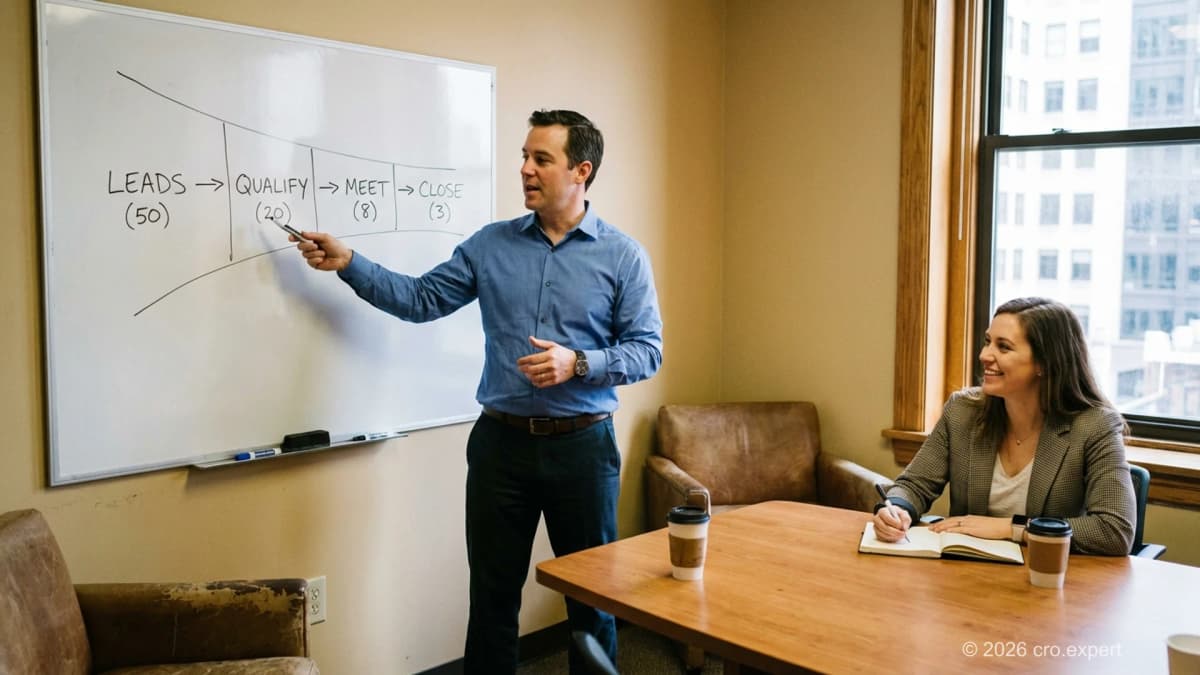
Weekly deal review cadence: the structure that works
The best deal review cadences aren't long. They're consistent. Here's the structure that separates the teams where this practice actually improves outcomes from the ones where it becomes another calendar obligation.
Before the meeting: two-minute manager prep
Before each review, the manager should pull up the three to five deals most likely to determine the quarter's outcome. Not the whole pipeline. Not the biggest deals by ACV. The ones where the next 10 days matter most.
Tag each with a simple pre-read: stage, last activity date, confirmed next step (yes/no), manager's gut check on close probability. This prep takes five minutes and makes the meeting 3x more focused.
The 30-minute structure
The meeting itself should follow a consistent rhythm:
- Minutes 0-5: Quick status scan. Rep confirms key deals are still active, flags any major changes.
- Minutes 5-25: Deep dive on two to three priority deals using the 4-question framework. This is where the coaching happens.
- Minutes 25-30: Documented next actions. The manager writes down what the rep committed to change or do. This is what gets reviewed next week.
The last five minutes are often skipped. Don't skip them. The documented next actions are what create accountability and make the coaching land rather than evaporate between sessions.
Frequency
Weekly is the right cadence for active pipeline. Monthly is too slow to catch problems before they affect the quarter. Daily is too frequent to produce behavioral change.
For deals in the final two weeks before expected close, a mid-week check-in of 10-15 minutes is worth adding on top of the weekly rhythm. Not to pressure the rep, but to remove blockers faster.
Who should attend
One manager, one rep. No exceptions during the coaching portion. Group pipeline reviews produce a different dynamic — reps perform for each other, managers inspect for the room, and no real coaching happens. Save group formats for pipeline coverage discussions with the full team. The coaching conversation needs to be private.
Manager accountability: the part most teams skip
Here's the uncomfortable thing about deal review as a coaching tool: it only works if the manager is also held accountable for outcomes.
Most organizations hold reps accountable for quota. Managers get held accountable for their team's number, which sounds similar but isn't. A manager who consistently inspects without coaching can hit team quota in a strong market and go completely unexamined.
The signal to look for is forecast variance by manager. A manager who runs genuinely coaching-oriented deal reviews should produce forecasts that are accurate within 10-15% of actuals. When a manager's team consistently over- or under-delivers against their own forecast, that's a coaching quality problem, not a rep talent problem.
What manager accountability looks like in practice
Senior leadership should review deal review session notes, not just pipeline reports. This doesn't need to be bureaucratic. A simple weekly shared document where managers log the two to three coaching commitments from each session is enough.
If nothing gets written down, nothing is being held accountable. If the log shows the same "need better discovery" note week after week, either the rep isn't improving or the coaching isn't working.
Managers should also own the escalation decision when deals are at real risk. Not reps. If a deal needs a senior executive intro, a competitive response, or a creative commercial structure, the manager should initiate that, not wait for the rep to ask.
For context on how to structure the manager's role within the broader revenue operating model, the advisory engagement model walks through what this looks like for B2B sales organizations at different stages of maturity.
Note
Forecast variance reveals coaching quality
If a manager's team consistently misses their own forecast by more than 20%, the root cause is almost always coaching quality, not rep talent. A manager running real deal review coaching produces accurate, manager-verified forecasts. Inspection-only reviews produce optimism with no anchor to reality.
Deal review benchmarks: frequency, Win Rate, forecast accuracy
These are the numbers worth tracking to know whether your deal review practice is actually working.
Review frequency and Win Rate
Reps who receive structured coaching through deal reviews at least weekly show measurably better Win Rates than those in monthly or ad-hoc review environments. CSO Insights data shows that organizations with a dynamic coaching process (manager-driven, deal-specific) achieve Win Rates 28% higher than those with informal or no coaching.
That gap is consistent across company sizes and industries. It's one of the most reliable return-on-investment cases in B2B sales operations.
Forecast accuracy benchmarks
For teams running coaching-oriented deal reviews:
- Commit-category deals: close within 10-15% of manager forecast
- Upside deals: close rate 40-60% (anything higher means you're under-committing)
- Deals stuck in the same stage 3+ weeks: flag as at-risk regardless of stage name
For teams still running pure inspection reviews, forecast variance often runs 30-40% in either direction. Buyers close early and managers didn't know, or deals fall out in the last week and no one saw it coming.
Time investment
Managerial coaching time has a documented sweet spot. Research cited by Pavilion shows that three to five hours per month per rep produces the best outcomes. Below that, coaching is too infrequent to change patterns. Above five hours per rep per month, marginal benefit drops significantly.
For a team of eight reps, that's 24-40 manager hours per month on structured coaching. If your managers currently spend less than that, you've identified where your Win Rate improvement is hiding.
Common deal review mistakes that kill coaching value
Covering too many deals
Trying to review 15 deals in 45 minutes forces every conversation to stay at the surface. You get a status update on all of them and coaching on none. A focused review of three to four deals produces more development value than a survey of 15.
Rule of thumb: if you can't spend at least five minutes on a deal, it shouldn't be in the coaching portion of the review.
Reviewing deals the rep knows you'll ask about
Some managers only review the deals in the forecast commit column. Reps quickly learn to keep those deals polished while letting the rest of the pipeline decay. Consider rotating which deals you review, including some from earlier stages and some from the rep's "unlikely" bucket.
Not following up on prior commitments
If you start each review without checking what the rep said they'd do differently last week, you signal that the coaching doesn't actually matter. The most important two minutes in any deal review is reviewing the previous session's documented actions before starting new ones.
Making it a one-way conversation
The manager talks, the rep listens, everyone leaves. Real coaching requires the rep to do the thinking out loud. The manager's job is to ask questions, not to provide answers. When a manager says "here's what you should do", the rep learns the answer but not the thinking. Next time they're stuck, they'll ask the manager again instead of diagnosing it themselves.
Fair warning: this shift in meeting dynamic feels slow at first. Asking questions when you know the answer is harder than just saying it. But within four to six weeks, you'll have reps who come to the review having already diagnosed the problem themselves.

Making the coaching shift stick across your team
Changing how deal reviews work is harder than it sounds. The status-update format is comfortable. Reps know how to perform in it. Managers have been doing it that way for years. The shift to a coaching model requires both parties to be less comfortable.
Start with one manager, one team. Don't try to roll this out organization-wide in week one. Pick the manager who is most open to changing their approach, run the new format for a quarter, and measure the output. Win Rate movement, forecast accuracy improvement, rep-reported coaching quality. Then use that evidence to expand.
The single most important change you can make today
End every deal review with a written commitment from the rep. Not a note in your system. An actual shared document that both the manager and rep can see. "Next week, I will do X differently on deal Y. The specific action is Z."
This alone changes the character of the meeting because both parties know it will be reviewed. The rep prepares more honestly. The manager follows up more specifically. And over time, reps start arriving with the diagnostic work already done, because they've learned what the manager will ask.
The deal review is the highest-leverage meeting in a sales organization. Used well, it's where coaching, forecast management, and deal execution all intersect. The teams that treat it as a status report are leaving Win Rate on the table every single week.
If you want to build this kind of operating rhythm across a larger team, or if your managers need support making the transition from inspection to coaching, see how advisory engagements are structured for exactly this kind of work.